
Throw-In Tactics: The Most Underrated Restart in Football
It is the most common restart in football and, for most of the sport's history, the least coached. The ball goes out, someone picks it up, throws it to the nearest teammate, and play resumes — thirty, forty, sometimes fifty times a match, every one of them a small coin flip that teams simply accepted. Then Liverpool hired a throw-in coach, the football world laughed for a week, and the laughter stopped when the results came in.
The logic behind the appointment of Thomas Gronnemark at Liverpool was embarrassingly simple: throw-ins are set pieces hiding in plain sight. Each one is a dead ball with a defence that has stopped running, yet possession statistics showed teams losing the ball from their own throw-ins at a startling rate. If a specialist could fix even part of that leak, the gains would be enormous — and they were.
Why throw-ins leak possession
The thrower's problem is structural. He stands still, outside the pitch, while every potential receiver is marked by a defender who can see both him and the ball. The safe throw goes backwards; the ambitious throw goes into a crowd; the panicked throw under pressure goes straight to an opponent. Multiply that by dozens of throws a game and a team quietly hands back a chunk of its possession without anyone noticing.
Gronnemark's work attacked the problem from three directions: technique, so throwers could deliver longer and flatter balls to feet; movement, so receivers created options with coordinated runs rather than standing marked; and awareness, so the thrower scanned before picking the ball up instead of after. None of it was revolutionary. All of it was simply coached, for the first time, with the seriousness other restarts already received.
The principles of a good throw-in
- The thrower scans the field before retrieving the ball, not after.
- Receivers move in coordinated pairs — one short, one long, one opposite.
- The throw goes to feet in space, not to a chest under pressure.
- Long throws are reserved for specific zones, not nostalgia.
- Losing the ball is planned for: the nearest players counter-press instantly.
The long throw: dinosaur or weapon?
The long throw into the box carries decades of baggage — the image of lower-league siege football, all elbows and chaos. The modern version is more selective. Data shows the long throw creates genuine danger only from specific zones within range of the box, so teams that retain it treat it like a corner: flat trajectories that arrive faster than crosses, designated flick men, and blockers rehearsed on the training ground. The flatness is the point — a thrown ball travels on a line no cross can match, and defenders attacking it face their own goal.
Outside those zones, the analytics verdict is blunt: the long throw is a turnover dressed as ambition. Possession-minded teams now keep the ball from deep throws almost as a point of principle, playing back to the goalkeeper and restarting with structure rather than flipping a coin in the mixer.
Defending the throw
The defensive side has professionalised in parallel. Organised teams now press the throw-in as a trapping opportunity: the receiver is played toward the touchline — the extra defender again — the second option is screened, and the panicked third throw becomes an interception. Some coaches build their entire sideline pressing scheme around the moment the ball goes out, because a trapped thrower has fewer options than any other ball-carrier on the pitch.
Defending the long throw has its own micro-science: attack the first contact zonally, station a man on the flick line, and push the defensive line up the moment the thrower's arms come down, so the second ball is contested in midfield rather than on the edge of the box.
| Throw situation | Modern best practice | What the data warns against |
|---|---|---|
| Deep in your own half | Keep it, play back, rebuild with structure | Hopeful throws down the line into pressure |
| Midfield third | Coordinated runs, throw to feet in space | Static receivers marked into a coin flip |
| Within range of the box | Flat long throw as a rehearsed corner | Floaty throws the keeper claims for free |
| Under a sideline trap | Quick switch or back-pass before the trap sets | The panicked third option straight to an opponent |
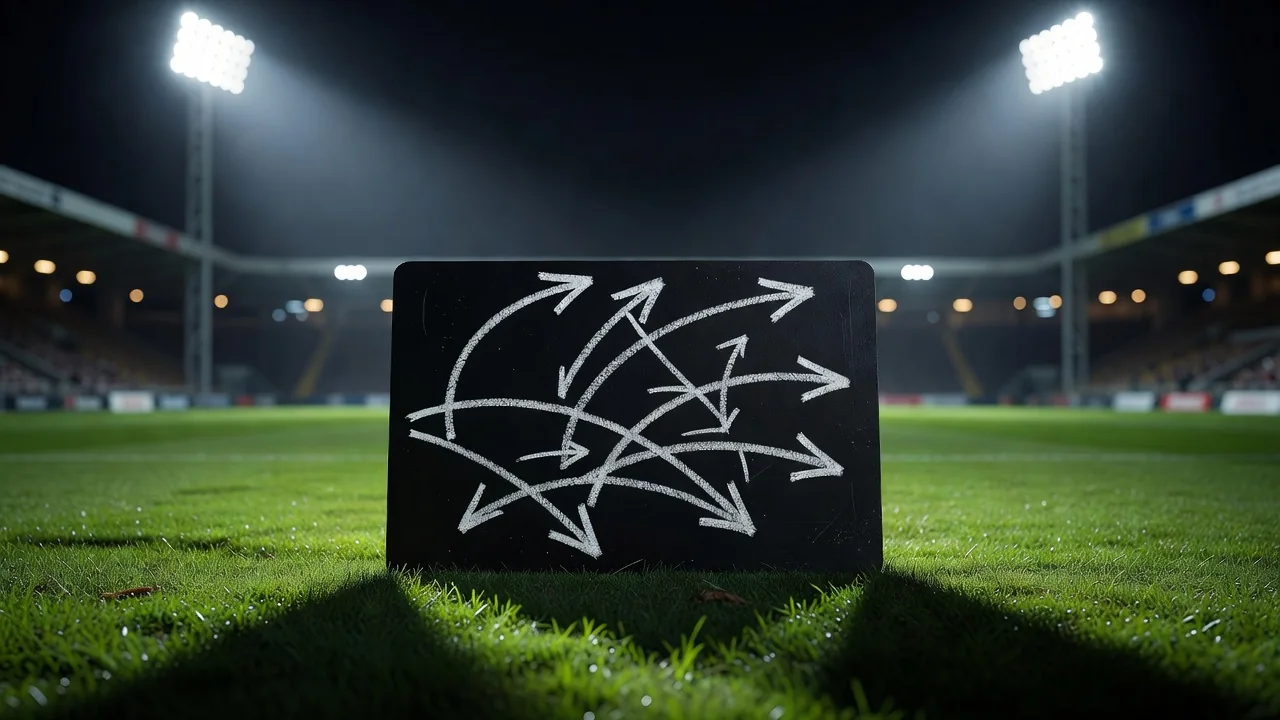
The ripple has spread through academies as well. Young players are now taught to take throws quickly and legally — feet planted, ball behind the head — not as an afterthought but as a skill that keeps attacks alive. Coaches at youth level report the same discovery Liverpool made: the team that treats every restart as an opportunity simply has the ball more, and having the ball more remains the closest thing football has to a universal advantage.
The throw-in's journey from afterthought to coached phase is the story of modern football in miniature: nothing is too small to analyse, and the margins everyone ignored turn out to be where matches hide. The next time the ball rolls out near the dugouts, watch the thrower's eyes. If he scanned before he bent down, someone on that staff did their job.
Keep reading
Corner Kick Routines: How Set-Piece Coaches Design Goals
Blocks, screens and decoy runs — the modern corner is choreographed like a dance. Inside the craft of the set-piece coach.
2026-08-11
Free Kick Tactics: Direct Shots, Layoffs and Decoy Runs
Not every free kick near the box should be shot at goal. The geometry of walls, layoffs and the rehearsed routines behind them.
2026-08-10
Defending Set Pieces: Zonal, Man-Marking or Hybrid?
Every coach has a religion on corners: zonal, man-to-man or a mix. What each system protects, what it risks, and why hybrids won.
2026-08-09