
Free Kick Tactics: Direct Shots, Layoffs and Decoy Runs

The free kick is football's purest tactical moment: the ball still, the wall set, twenty-two players arranged by design and everyone in the stadium knowing something is about to happen. For decades the conversation started and ended with the great direct specialists. Modern analysis has widened the lens — the free kick near the box is now a family of designed plays, of which shooting over the wall is only one, and often not the best.
What changed is the arithmetic. Defences improved, goalkeepers got better at reading flight, and the wall became a coached unit with jump timing and a player lying behind it to kill the low shot under the jump. The direct strike remained a weapon for the few who bend the ball exceptionally, but the expected return on a routine blast into the wall fell enough that coaches went looking for better options.
The geometry of the wall
Every free-kick decision starts with the wall's construction. The defending team chooses how many players to commit, and that choice shapes the attack's options. A big wall protects the shot but strips defenders from the rest of the box; a small wall invites the strike but keeps numbers back to defend the cross or the layoff. Attacking teams read this like a poker tell: the size and position of the wall often announces what the defence fears most.
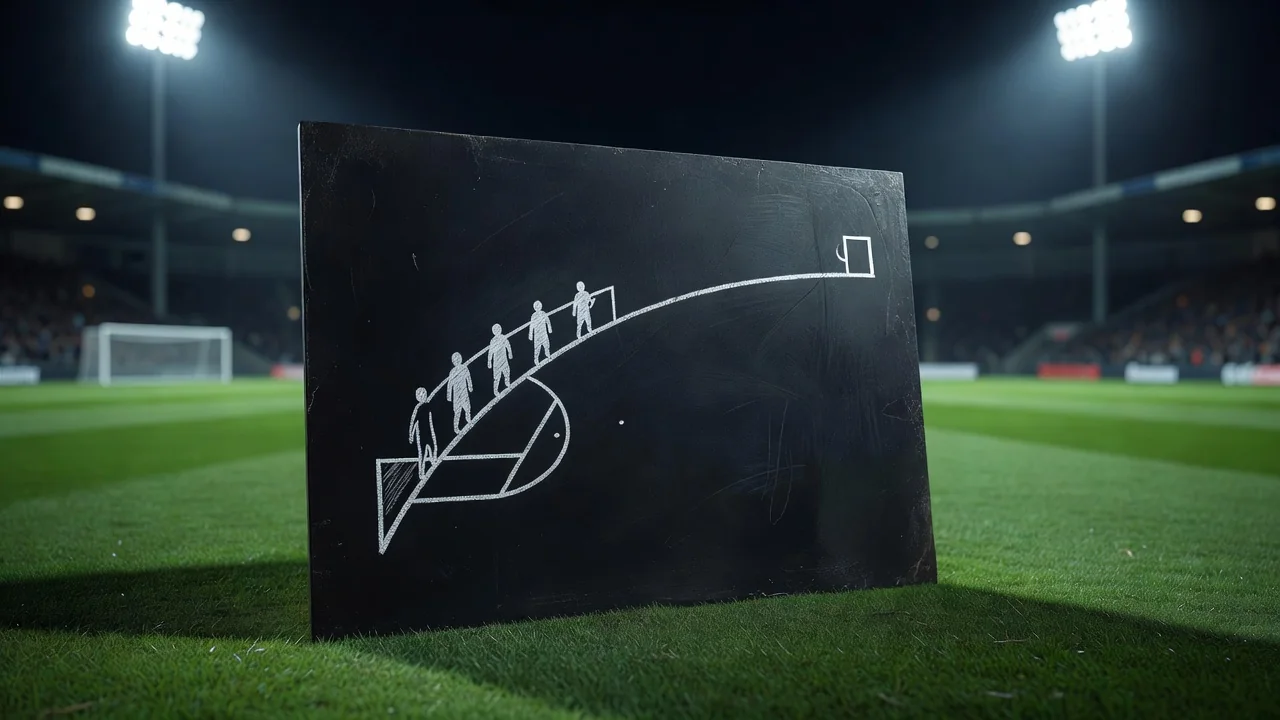
The attacking side places its own bodies in and around the wall — the famous infiltrators — to block the goalkeeper's sightline, unsettle the jump, or peel away at the last instant to open the shooting lane the wall was covering. What looks like jostling is in fact the first move of a rehearsed play.
The menu beyond the direct shot
- The layoff, where one attacker stops the ball for a teammate's cleaner strike.
- The decoy run across the wall, dragging defenders before a clipped pass behind.
- The quick free kick before the wall is set, while the defence argues.
- The wide free kick treated as a corner, loaded with the same routines.
- The chipped ball over the wall for a runner attacking the space behind it.
When the direct shot is still king
None of this erases the specialist. A genuinely elite striker of the ball changes the defence's entire calculation, because the threat of the direct shot forces the wall to commit — and every player in that wall is a player not marking in the box. The greatest free-kick takers bend the ball over or around the wall with enough consistency that teams alter their fouling behaviour near their own box, defending more cautiously in the zones where the specialist operates. That deterrent effect never appears in any stat, yet coaches swear it shapes whole matches.
The layoff exists to multiply that threat. With a defender lying behind the wall to block the low shot and the wall jumping to block the high one, the stopped ball for a second taker attacks the split second when the wall is airborne and the goalkeeper is unsighted — a routine as rehearsed as any corner.
Wide free kicks: corners in disguise
From the touchline zones, the free kick has quietly merged with corner strategy. The same principles apply — blockers, decoy runs, near-post flicks, back-post overloads — with one advantage: the angle of delivery is often better than from the corner arc, allowing a flatter, faster ball that defenders must attack while facing their own goal. Set-piece coaches treat the wide free kick as a premium chance and rehearse it with the same detail.
Deep free kicks from the halfway line have their own design: the diagonal to the back post for the tallest attacker, or the short restart that catches a defence pushing up for an offside trap that was never coming. Even the most hopeful-looking punt into the box is, at the top level, a play with named roles.
| Free-kick choice | Best used when | Main risk |
|---|---|---|
| Direct shot over the wall | Elite specialist, central position | Wall jump plus keeper positioning kills all but the best |
| Layoff to a second taker | Wall prone to jumping early | A slow layoff lets the defence rush out |
| Chip behind the wall | Wall tight, runners attacking the blind side | Goalkeeper claiming everything flat |
| Wide delivery as a corner | Aerial advantage in the box | Counter-attack if the delivery fails |
There is one more layer the analytics era added: shot location data now tells coaches exactly where their taker is dangerous, and the pre-match plan includes instructions about where to invite fouls and where to avoid conceding them. Defending teams drill their midfielders on tackling technique in the red zones around the box, because giving away the wrong free kick has become a measurable, nameable error.
The next time a team lines up a free kick at the edge of the box, watch the two seconds before the strike: the infiltrator stepping out of the wall, the decoy starting his run, the taker's glance. The direct screamer will always own the highlights — but the modern free kick is a playbook, and the goal you are about to see was drawn on a tactics board on Thursday.
Keep reading
Corner Kick Routines: How Set-Piece Coaches Design Goals
Blocks, screens and decoy runs — the modern corner is choreographed like a dance. Inside the craft of the set-piece coach.
2026-08-11
Defending Set Pieces: Zonal, Man-Marking or Hybrid?
Every coach has a religion on corners: zonal, man-to-man or a mix. What each system protects, what it risks, and why hybrids won.
2026-08-09
Throw-In Tactics: The Most Underrated Restart in Football
Liverpool hired a coach just for throw-ins — and it worked. Why the humblest restart is a set piece hiding in plain sight.
2026-08-08