
5-4-1 Formation Explained: Defending Deep to Strike Once
Nobody dreams of coaching the 5-4-1. It is the formation of teams that look at the fixture list, look at their squad, and make an honest deal with reality: we will not have the ball, we will not have the better players, so we will have the better organisation. Five defenders, four midfielders, one striker who will spend the evening alone — and, often enough to keep the idea alive, a famous result at the end of it.
The 5-4-1 is the deepest mainstream shape in football. Three centre-backs, two wing-backs who become full-backs, a flat midfield four, and a lone forward. It exists to defend the penalty area with numbers and to attack on the counter with two or three players at most. Judged as entertainment it is a hard sell; judged as a tool, it does a specific job better than anything else.
The architecture of a fortress
The back five is the formation's heart. With three centre-backs, the penalty box is crowded in a way no back four can match: one central defender attacks the ball, the other two sweep either side, and crosses meet a wall of headers. The wing-backs drop to complete the line without the ball, turning the shape into a genuine five across the back — and the width of the pitch, which the system concedes by design, stops mattering because everything funnelled wide comes back in as a cross into traffic.
Ahead of them, the flat midfield four sits narrow, usually within thirty metres of its own goal. The four do not press high and rarely step into the opponent's half; their job is to close the lanes into the striker and the spaces between the lines, forcing play around the outside and then sliding across as a unit. It is exhausting, unglamorous running — and it is coached in as much detail as any attacking pattern.
What the shape concedes on purpose
- Possession, almost always and without apology.
- The flanks, until the cross arrives in a crowded box.
- Long shots from outside the area.
- Territory, everywhere except the final thirty metres.
- The ball at the feet of the opponent's centre-backs.
The loneliest job in football
The single striker in a 5-4-1 performs a role closer to decoy than forward for long stretches. His first job is to give the defence a target for clearances: hold the ball up against two centre-backs, win free kicks, let the block breathe and reset. His second is to be ready for the one or two moments a match when a clearance becomes a counter — a channel ball to chase, a set piece won by the pressure he applied to a panicked defender.
This is why the system's striker is chosen for different qualities than a favourite's forward. Pace over polish, work over flair, and above all the temperament to touch the ball a dozen times in ninety minutes and still sprint for the thirteenth. Managers who have made careers with underdogs speak about this position first when they recruit.
The counter-attack as the entire attack
With one striker and a midfield four camped deep, the 5-4-1 cannot build sustained pressure — so it does not try. The attacking plan is a rehearsed handful of breaks: the long diagonal into the channel, the set piece loaded with the three centre-backs, the second ball after a cleared cross. Goals from open play moves of fifteen passes are not missed, because they were never budgeted for. The formation's xG totals are among the lowest in any league; its coaches would point out that its opponents' are often lower.
When the fortress becomes a trap
The 5-4-1's failure mode is well documented. Defend deep enough and the pressure becomes cumulative: clearances return, corners stack up, and the one ricochet that decides such matches arrives eventually. Chasing a game in this shape is nearly impossible — the squad and the habits are built for protecting, not creating. And when the wing-backs lack the legs to join counters, the striker's isolation becomes total, and the team defends its way to a series of honourable one-nil defeats.
| Element | Designed to do | Cost of the design |
|---|---|---|
| Back five | Own the penalty box against crosses and cutbacks | Concedes the entire width of the pitch |
| Narrow midfield four | Block the lanes between the lines | No platform for sustained attacks |
| Lone striker | Outlet for clearances, threat on the break | Isolated against two centre-backs all match |
| Set-piece focus | Weaponise the few dead balls earned | Plan collapses when referees swallow the whistle |

There is also a version of the shape that appears only in emergencies. Favourites down to ten men, teams protecting a lead in stoppage time, visitors clinging to a draw in a hostile away leg — all of them drift into a de facto 5-4-1 without ever naming it. That tells you the formation is less a philosophy than football's emergency brake, installed in every squad whether the coach admits it or not.
It is easy to sneer at the 5-4-1 until you watch a well-drilled one erase a superior side for ninety minutes. Football's pyramid runs on teams that cannot afford beautiful football, and this formation — honest, exhausting, and quietly sophisticated — remains their most reliable instrument.
Keep reading
4-3-3 Formation Explained: Strengths, Weaknesses, Variants
The shape of Barcelona's great sides and most of modern football. Why the 4-3-3 dominates, and the midfield balance it secretly depends on.
2026-08-21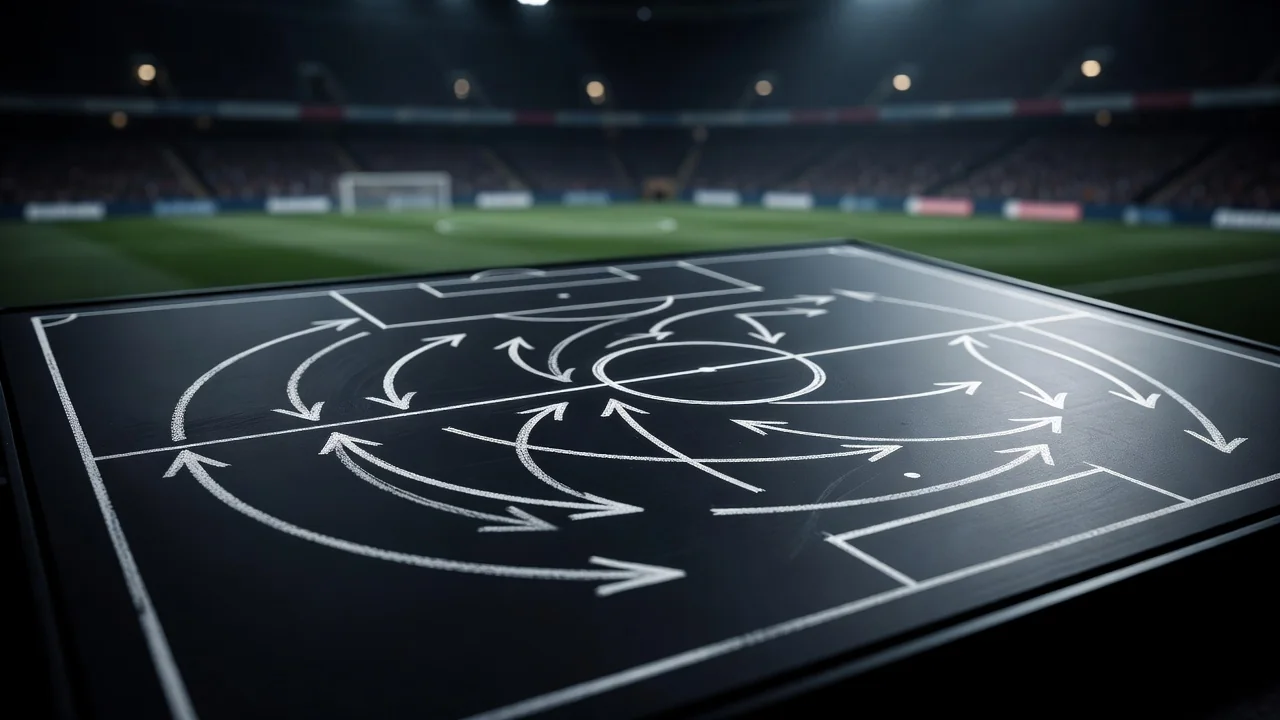
3-5-2 Formation Explained: Wing-Backs and Midfield Overloads
Italy's old love, Conte's weapon, the shape of two strikers. The 3-5-2 lives and dies on the legs of its wing-backs.
2026-08-20
4-2-3-1 Formation Explained: The Modern Default Shape
Two holders, a creator, a striker — the 4-2-3-1 became football's safest choice. Why so many coaches start here and what it costs.
2026-08-19