
Tactical Analysis Glossary: Football Terms Every Fan Should Know
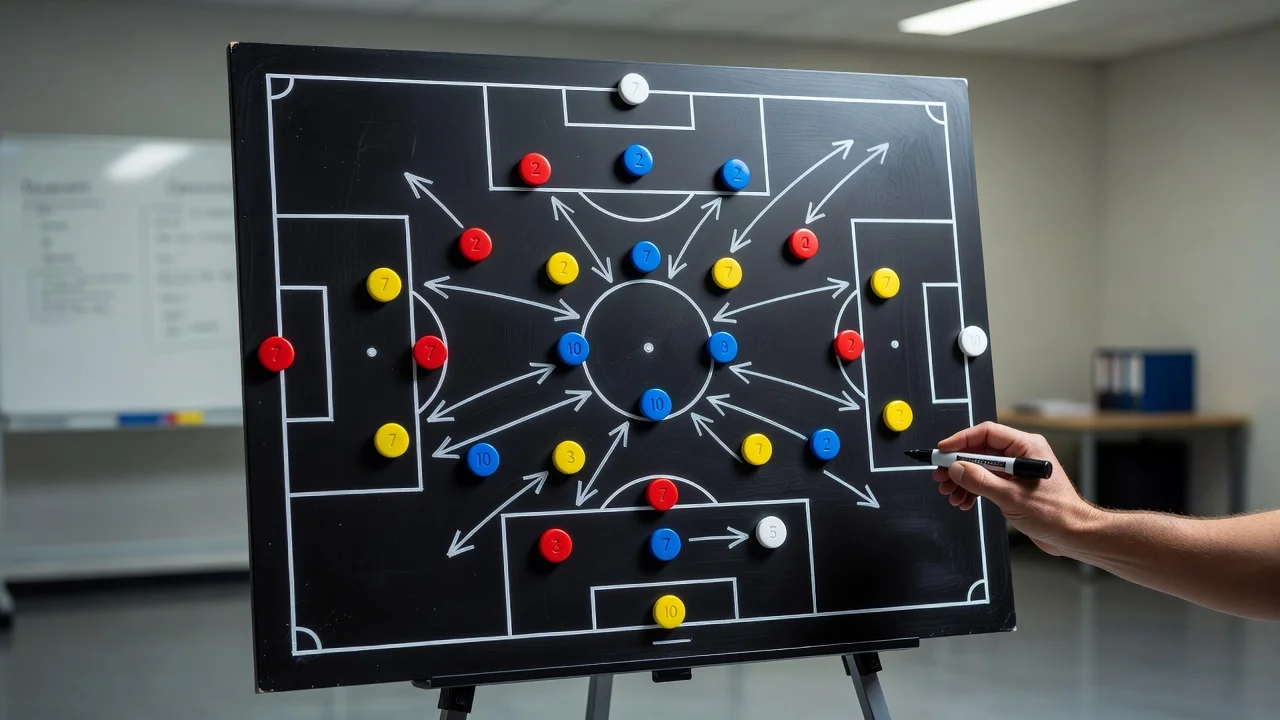
Football has always had a language problem. The game itself is universal — a ball, a pitch, two goals — but the way professionals talk about it has drifted further and further from the vocabulary of the stands. A pundit says "they're playing a 4-2-3-1 with a false nine and a rest-defence of three" and half the audience switches off, not because they do not care but because the words sound like a foreign dialect invented in a coaches' seminar. In a sense, they were. Most of the terminology used in modern tactical analysis was borrowed from other languages, repurposed from academic disciplines or coined by analysts on Twitter, and only later filtered into mainstream broadcasting. The result is a gap between the expert and the fan that is not about knowledge but about vocabulary. Close the vocabulary gap and the tactical conversation opens up immediately, because the concepts themselves are not complicated — they just have names that nobody explained.
Formations and shapes: the grammar of the game
Before diving into tactical concepts, it helps to establish the foundational vocabulary of formations and shapes, because every other tactical discussion builds on these terms. A formation is the numerical arrangement of players, written as a string of numbers from defence to attack — 4-3-3 means four defenders, three midfielders, three forwards. But a formation is only a starting position, a snapshot of the team's shape at the moment the ball is in a neutral state. What matters tactically is how that shape transforms when the team has the ball, loses the ball or defends deep.
A team that lines up in a 4-3-3 may play in possession as a 3-2-5, with a full-back tucking into the back line and a midfielder pushing high to create a front five. The formation label describes the defensive structure; the attacking shape is a different animal. This is why analysts increasingly use "in-possession shape" and "out-of-possession shape" as separate descriptors, because a single formation number cannot capture the transformation that occurs during a match.
The most common formation and shape terms you will encounter include:
- Back four / back three — the number of defenders in the deepest line. A back four typically uses two centre-backs and two full-backs; a back three uses three centre-backs, often with wing-backs ahead of them providing width.
- Single pivot / double pivot — the defensive midfield position. A single pivot is one holding midfielder anchoring the centre; a double pivot uses two, providing more defensive security but fewer bodies further forward.
- Inverted winger — a wide attacker who starts on the wing but cuts inside onto their stronger foot, moving into central areas rather than staying wide. A left-footed player on the right wing is the classic example.
- Wide forward — a wide attacker who stays close to the touchline to stretch the defence, rather than cutting inside. The distinction from an inverted winger is the direction of movement: wide forwards go outside, inverted wingers go inside.
- False nine — a central striker who drops deep into midfield rather than staying high against the defensive line. The movement pulls a centre-back out of position, creating space behind for wingers or attacking midfielders to exploit.
- Box-to-box midfielder — a central midfielder who contributes in both penalty areas, supporting attacks and tracking back to defend. The term describes a role, not a position on a formation chart.
- Wing-back — a hybrid role between full-back and winger, used in back-three systems where the wide defender has more freedom to attack because three centre-backs provide defensive cover.
Each of these terms describes a structural choice that a coach makes, and each choice carries tactical implications. A back three with wing-backs provides width without sacrificing central defensive cover. A back four with inverted wingers creates central overloads but leaves the full-backs responsible for providing width. The formation is the starting point; the tactical intent is revealed in how the shape transforms during play.
Space and zones: where tactical battles are won
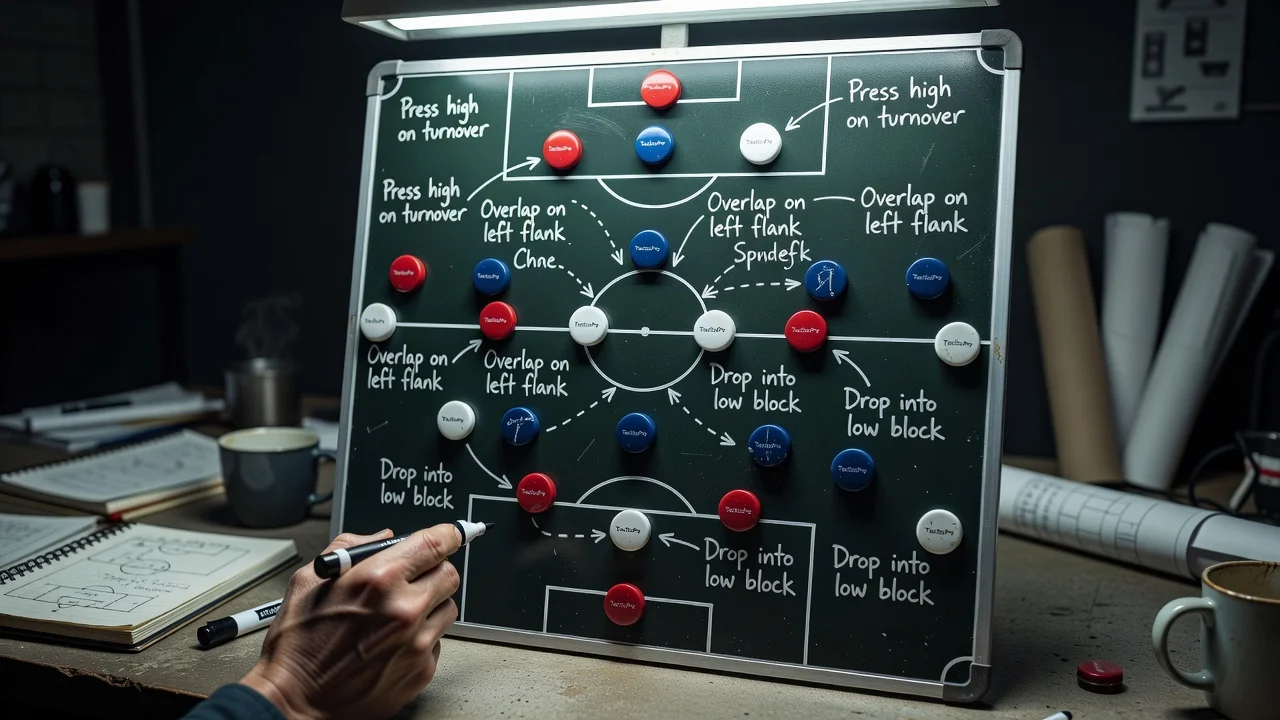
If formations are the grammar, spatial terms are the vocabulary that describes where things happen. The pitch is not a uniform green rectangle — it is a network of zones, channels and spaces that have different tactical value depending on where the ball is and which team is in possession. Understanding the names of these spaces is the key to understanding why teams move the way they do.
The concept of space is central to everything in tactical analysis. A team's attacking strategy is fundamentally about creating and exploiting space. A team's defensive strategy is about denying and compressing space. Every movement, every pass, every pressing action is either opening or closing a zone on the pitch, and the names for these zones allow analysts to describe the battle with precision.
The spatial terms that appear most frequently in tactical analysis are:
- Half-space — the vertical channel between the wing and the central corridor. On a pitch divided into five vertical lanes — left wing, left half-space, centre, right half-space, right wing — the half-spaces are the second and fourth lanes. They are tactically valuable because a player in the half-space can play passes to both sides and shoot from angles, while a defender marking them must choose whether to follow inside or hold position. Half-spaces are where many modern attacking patterns concentrate.
- Between the lines — the horizontal space between the opponent's defensive and midfield lines, or between their midfield and forward lines. A player operating "between the lines" is positioned in a gap that the defensive structure does not naturally cover, making them difficult to mark without a defender leaving their assigned zone. Attacking midfielders and false nines frequently operate in this space.
- The channel — the vertical gap between two defenders, typically between a centre-back and a full-back. Attacking runs into the channel exploit the uncertainty of which defender is responsible for the runner. Wide forwards and strikers make channel runs to receive through balls.
- The pocket — a small, specific zone of space, usually referring to the area just in front of the defensive line where a creative midfielder can receive and turn. "Receiving in the pocket" means collecting the ball with time and space to play forward.
- Overload — a numerical advantage in a specific area. A 3v2 on the wing is an overload. Overloads create passing options and force the defence to shift, which opens space elsewhere.
- Underload — a numerical disadvantage in a specific area, often created deliberately to draw the opposition toward one side before switching play to the underloaded side where space has opened up.
- First line, second line, third line — horizontal layers of pressure in a pressing structure. The first line is the forwards who initiate the press; the second line is the midfielders who cover passing lanes; the third line is the defenders who provide the deepest cover.
- Last line — the defensive line closest to the goal. Breaking the last line means playing a pass or making a run that gets behind the deepest defenders.
The spatial vocabulary allows analysts to describe not just what happened but where it happened and why that location matters. A pass into the half-space between the lines is not just a pass — it is a penetration into a high-value zone that forces the defence to make a decision. The location of the action is the tactical content.
Pressing and defensive concepts: the vocabulary of intensity
Pressing is the area where tactical vocabulary has expanded most rapidly in the past decade. The terms originated in German coaching education in the 1990s, entered English through translated coaching manuals and have since been adopted by broadcasters, journalists and fans. Understanding these terms is essential because pressing is not a single action — it is a spectrum of collective defensive behaviours with different triggers, intensities and objectives.
The terms below represent the core defensive and pressing vocabulary used in modern tactical analysis.
| Term | Definition | Tactical purpose | Example in practice |
|---|---|---|---|
| Gegenpressing | Immediate, aggressive pressing after losing possession, typically within five seconds of the turnover | Prevent the opponent from counter-attacking by winning the ball back high up the pitch | Liverpool under Klopp: the moment a pass is intercepted, the nearest three players sprint to the ball |
| Counter-pressing | Synonymous with gegenpressing, sometimes used to describe a slightly more measured version | Win the ball back quickly in the zone where it was lost, before the opponent can organise | Manchester City under Guardiola: players compress around the ball-carrier immediately after losing it |
| High press | Pressing the opponent's build-up near their own goal, with forwards closing down centre-backs and the goalkeeper | Force errors in dangerous areas, win the ball close to the opponent's goal | Bayer Leverkusen: the striker chases the goalkeeper, cutting off short passing options |
| Mid-block | Defensive positioning between the halfway line and the defensive third, with moderate pressing intensity | Delay the opponent's progression, invite them into a compressed zone where turnovers are likely | Atletico Madrid: the forwards drop to the halfway line and press only when the ball enters a trigger zone |
| Low block | Deep defensive positioning in or near the own penalty area, with minimal pressing | Minimise space behind the defensive line, force the opponent to play in front of the block | A team defending a one-goal lead in the 85th minute: all eleven players behind the ball |
| Pressing trigger | The specific event or action that initiates a coordinated press — a backward pass, a touch to a particular foot, a ball played to a particular zone | Create predictability: the team knows when to press as a unit because the trigger is pre-defined | "We press when the ball goes to the full-back" — the moment the pass is played, the winger, eight and nine compress |
| Cover shadow | The space behind a pressing player that is blocked from direct passing lanes by their positioning | A pressing player positions themselves to block a pass to the player behind them, effectively marking them without direct engagement | A midfielder pressing a centre-blocks the pass to the opposing ten by standing in the passing lane |
| Compactness | The horizontal and vertical distance between defensive players, measured as the space between the lines and between the wide players | Reduce the gaps that the opponent can exploit, force play into congested areas where turnovers are likely | A team reducing the distance between its midfield and defensive lines from 20 metres to 8 to deny through balls |
| Rest-defence | The players who remain behind the ball during an attacking phase to protect against counter-attacks | Maintain a numerical advantage or balance behind the ball so that a turnover does not lead to an immediate counter | Two full-backs and a defensive midfielder staying at the halfway line while the team attacks with seven players |
| Trap | A deliberate defensive structure that invites the ball into a specific zone, then compresses around the ball-carrier to win possession | Create a predictable situation where the opponent plays into a pre-designed pressing area | A team allows the goalkeeper to pass to a full-back, then traps the full-back with the winger, eight and nine |
The vocabulary in this overview reveals that pressing is not about running hard — it is about running with purpose. Every pressing action has a trigger, a target and a covering structure behind it. A team that presses without a trigger presses chaotically and concedes. A team that presses with defined triggers, cover shadows and compactness can win the ball back in dangerous areas repeatedly. The terms exist because the concepts are real and observable, and once you know the names, you see the patterns in every match.

Possession and attacking concepts: the vocabulary of creation
On the attacking side of the ball, the vocabulary has evolved to describe not just what players do but the structural philosophy behind their actions. The shift from describing individual actions — "he passed, he dribbled, he crossed" — to describing collective patterns — "they created a third-man combination through the half-space" — reflects a deeper understanding of how attacking play is constructed.
Possession-based football has generated some of the most widely used and most misunderstood terms in the tactical vocabulary. Positional play, the framework that underpins the attacking philosophy of Pep Guardiola, is perhaps the most important and most frequently misused term in modern football analysis. Positional play, or "posicionamento" in its original Portuguese, is not about keeping the ball for its own sake. It is a structured system of positioning that creates numerical and spatial advantages by distributing players across specific zones of the pitch according to principles of width, depth and numerical superiority.
The core principles that define positional play and related attacking concepts include:
- Numerical superiority — having more players than the opponent in a specific zone. A team building from the back might create a 3v2 against the opponent's first pressing line by dropping a defender between two others or pushing a midfielder between the centre-backs. The principle is simple: if you have more players than the opponent in the area where the ball is, you have passing options and they have fewer defenders to close them down.
- Positional superiority — an advantage created not by numbers but by positioning. Two attackers can occupy three defenders if their positioning draws the defenders out of their optimal covering positions, creating space for a teammate elsewhere. Positional superiority is the refinement of numerical superiority — it works even when the numbers are equal.
- Progressive pass — a pass that moves the ball significantly forward, typically defined as a pass that advances the ball at least ten metres toward the goal or enters the final third from a deeper zone. Progressive passes are a key metric in player evaluation because they measure a player's contribution to moving the team toward the goal, regardless of whether the pass leads directly to a chance.
- Line-breaking pass — a pass that travels through a line of the opponent's defensive structure, typically between the midfield and defensive lines. Line-breaking passes are the most effective way to penetrate a compact block, because they move the ball past a line of defenders while keeping possession.
- Third-man run — a movement where player A passes to player B, who lays the ball off to player C, who has made a run to receive. The third man — player C — is the one who penetrates, and the pass to them is enabled by the intermediate pass to player B. Third-man runs are difficult to defend because the defence tracks the first two actions and loses sight of the third runner.
- Switch of play — a pass or sequence of passes that moves the ball from one side of the pitch to the other, typically to exploit an underloaded side where the defence has not yet shifted. Switches of play are the counter to defensive compactness — if the defence compresses on one side, the switch exploits the space left on the other.
- Occupation of space — the deliberate positioning of players in specific zones to stretch, compress or manipulate the opponent's defensive structure. A winger hugging the touchline occupies the width, stretching the defence horizontally. A striker occupying the last line pins the centre-backs deep, creating space between the lines for midfielders.
- Ball progression — the act of moving the ball from deeper zones toward the opponent's goal through passes, carries or dribbles. Ball progression is the connective tissue of attacking play — the team that progresses the ball efficiently creates more chances than one that circulates possession without advancing.
These principles are not independent — they interact constantly. Numerical superiority creates passing options, which enable line-breaking passes, which create space for third-man runs, which are enabled by the occupation of space that stretches the defence. The vocabulary describes a connected system, and understanding the connections is what makes tactical analysis coherent rather than a list of buzzwords.
Metrics and data terms: the quantitative layer
The integration of data analysis into football has introduced a new layer of vocabulary that sits alongside the tactical terms. These metrics — derived from event data collected during matches — quantify aspects of performance that were previously described only in qualitative language. A player who "creates a lot of chances" can now be described as generating 0.35 xA per 90 minutes, and the number adds precision to the observation.
The most important metrics for a fan to understand are relatively few, and each one answers a specific question about performance. Expected goals (xG) measures the quality of a shot based on the historical probability of similar shots being scored, using factors like distance, angle, body part and defensive pressure. A shot with an xG of 0.15 has a 15% chance of being scored based on comparable shots in the dataset. Over a season, a striker with an xG of 20 who has scored 18 is slightly underperforming their chance quality; one who has scored 24 is overperforming, which may indicate exceptional finishing or unsustainable luck.
Expected assists (xA) measures the quality of a pass that leads to a shot, using the same framework as xG applied to the receiving player. A player with high xA is creating high-quality chances for teammates, even if those teammates do not convert them. Shot-creating actions (SCA) and goal-creating actions (GCA) are broader measures that credit any action — a pass, a dribble, a foul won — that leads directly to a shot or a goal, providing a fuller picture of creative contribution than xA alone.
Possession-adjusted metrics normalise a player's statistics based on how much of the ball their team has. A defender on a team with 40% possession will make more tackles and interceptions than one on a team with 70% possession, not because they are better defensively but because they defend more. Adjusting for possession share allows fair comparison between players in different tactical systems.
The distinction between these metrics and the tactical vocabulary is important. Metrics describe outcomes — how many, how often, how good. Tactical terms describe processes — how, why, where. A complete analysis uses both: the metric tells you what is happening, and the tactical term tells you why. A team with low xG per shot is taking low-quality chances, but the tactical reason might be that their attacking patterns do not create penetration into the box, forcing players to shoot from distance. The metric identifies the problem; the tactical vocabulary diagnoses the cause.
How the vocabulary changes the experience of watching
The purpose of learning this vocabulary is not to sound knowledgeable in a pub discussion. It is to see the game differently. When you know what a cover shadow is, you notice the midfielder standing in a passing lane rather than chasing the ball, and you understand why the opponent cannot play the pass they want. When you understand what a pressing trigger is, you see the moment the entire team begins to move — not as a random burst of energy but as a coordinated response to a pre-defined cue. When you know what a half-space is, you notice the attacker drifting into the channel between the wing-back and the centre-back, and you see the defensive dilemma it creates before the pass is even played.
Football is a game of structures, decisions and patterns, and the vocabulary of tactical analysis gives names to those structures so that they can be seen, discussed and understood. The terms are not jargon designed to exclude — they are tools designed to illuminate. Learning them is the difference between watching a match and reading one, and the transition is available to anyone willing to learn the language.