
How to Build a Tactical Notebook from Match Clips and Notes

Every coach has experienced the same frustration. You watch a match, notice a pressing trigger that catches the opposition midfield building play on the left side, and think: I need to remember this. Two weeks later, you are preparing for a team that uses a similar build-up structure, and the memory is gone — a vague impression of something you once saw, with no clip, no timestamp, no note, no way to retrieve it. The difference between coaches who grow and coaches who stagnate is not talent or experience. It is the system they use to capture what they observe and convert it into something they can act on. A tactical notebook is that system. It is not a diary of opinions or a folder of saved videos. It is a structured, searchable repository of clipped match moments, tagged observations and analytical notes that turns passive viewing into an active learning process. Building one does not require expensive software or a data science degree. It requires a method, and the discipline to follow it.
What a tactical notebook actually is
The term "tactical notebook" gets thrown around loosely, so it helps to define what it is and what it is not. A tactical notebook is a personal database of football observations organised in a way that allows you to search, retrieve and connect patterns across matches, teams and players. It combines three elements: video clips of specific match moments, written notes attached to those clips, and a tagging system that lets you find both later by theme, team, phase of play or tactical concept.
What it is not is equally important. It is not a collection of full-match recordings — storing ninety minutes of footage teaches you nothing if you never revisit the specific moments that matter. It is not a scout's report on an individual player — it is broader, focused on tactical patterns rather than player evaluation. And it is not a coaching manual or a textbook — it is built from your own observations, in your own language, reflecting the things that you noticed and that matter to your specific coaching context.
The notebook is personal because tactical understanding is personal. Two coaches watching the same match will notice different things, care about different patterns and draw different conclusions. A notebook built by a grassroots youth coach focused on 4-3-3 pressing structures will look nothing like one built by a senior analyst tracking inverted full-back movements in a 3-2-4-1. The system — the method of capturing, tagging and retrieving — is transferable. The content is uniquely yours.
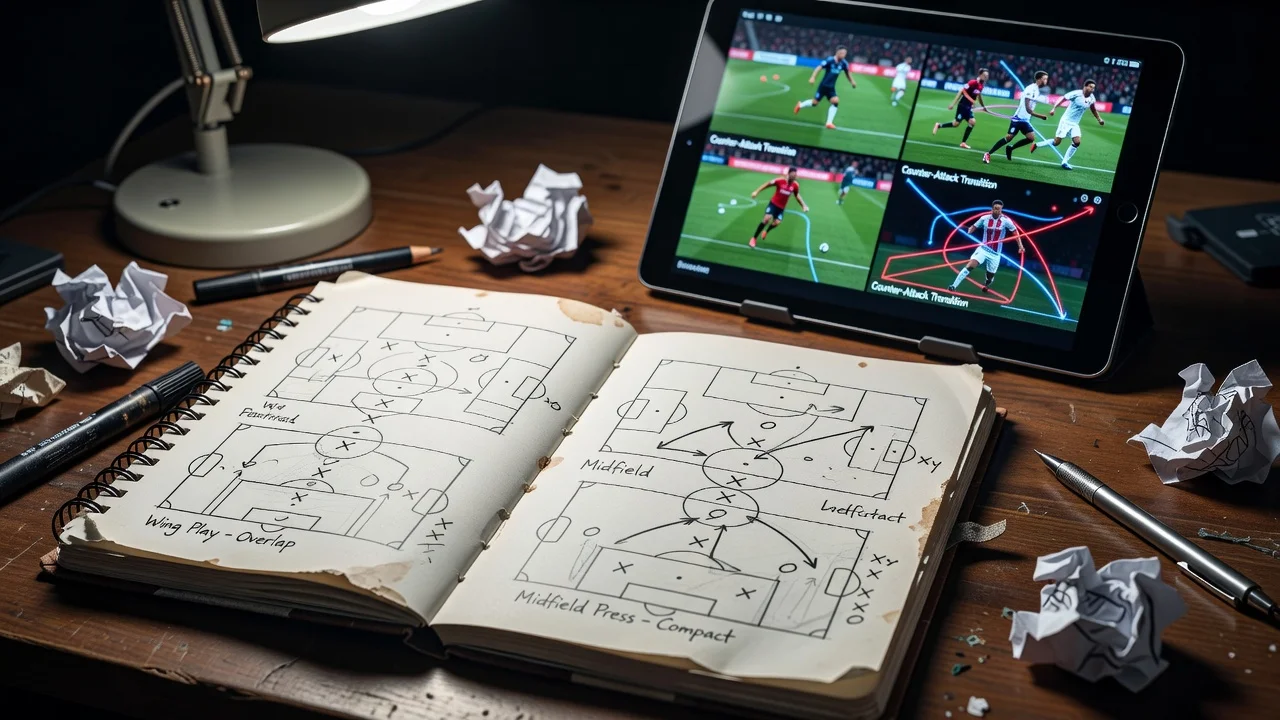
Starting with the right tools
The tools question is where most people stall. They assume they need a professional video analysis platform like Wyscout or Instat, and when the subscription cost runs into thousands of euros, the project dies before it starts. A functional tactical notebook can be built with free or low-cost tools that are already on your laptop or phone.
The essential toolset is modest. You need a way to clip video — VLC Media Player is free and allows frame-by-frame navigation and basic clipping. You need a way to store and organise those clips — a structured folder system on your computer or cloud storage works fine. You need a way to write notes and attach them to clips — a note-taking app that supports linking and tagging, such as Notion, Obsidian or even a well-structured Google Doc. And you need a way to replay clips with timestamp references — any video player with a jump-to-time function suffices.
The difference between a free toolset and a professional platform is convenience, not capability. A professional platform tags actions automatically, pulls data from multiple matches simultaneously and generates heat maps with one click. A free toolset requires manual work — you find the moment, you clip it, you tag it, you write the note. That manual work is actually an advantage for learning, because the act of finding, clipping and describing a tactical moment forces you to engage with it deeply. Automatic tagging lets you skim. Manual tagging makes you think.
Building your tagging system: the foundation
The tagging system is the backbone of the notebook. Without consistent tags, your clips are a folder of unconnected video fragments that you will never search effectively. With a well-designed tag system, you can query your notebook the way a data scientist queries a database: "show me every clip of a high press being beaten with a long diagonal switch in the last twelve months" and get instant results.
The key to a useful tagging system is choosing categories that reflect how you actually think about the game. Tags should correspond to the questions you ask when preparing for a match or evaluating a tactical idea. If you coach a team that presses in a 4-4-2, your tags should capture the specific pressing triggers, positioning details and outcomes that matter to that system. A tag like "high_press" is too broad to be useful; a tag like "high_press_442_ball_to_fullback_under_pressure" is specific enough to retrieve exactly the clips you need.
Before creating tags, it helps to understand the dimensions that most coaches use to categorise tactical moments. These dimensions form the axes along which every clip can be classified, and together they create a multi-dimensional filing system that makes retrieval precise and fast.
The following tagging dimensions form the core structure of a functional tactical notebook:
- Phase of play — the broadest category. Tags include: offensive_organisation, offensive_transition, defensive_organisation, defensive_transition, set_piece_attack, set_piece_defence. Every clip belongs to one of these phases.
- Pitch zone — where the action occurs. Divide the pitch into zones: defensive_third, middle_third, final_third, wide_left, wide_right, central. More granular systems use eighteen or more zones, but six to nine is sufficient for most coaching contexts.
- Tactical concept — the specific idea the clip illustrates. Tags like: pressing_trigger, build_up_from_back, overloads, third_man_run, compactness, line_pressure, cover_shadow, rest_defence. These are the conceptual building blocks of your tactical vocabulary.
- Formation context — the shapes involved. Tags like: 433_vs_4233, 3421_vs_442, 4233_in possession. This lets you search for patterns within specific formation matchups.
- Outcome — what happened. Tags like: successful, unsuccessful, turnover, shot_created, chance conceded. Outcome tags allow you to filter for clips where a tactical concept worked or failed.
- Team — which team is executing the action. Using team names or shorthand (e.g., LIV, MCI, RMA) lets you search for all clips of a specific team's behaviour.
- Player role — which position is involved. Tags like: fullback, six, eight, ten, nine, winger. This is useful when studying how a specific role functions within a system.
- Note type — what kind of observation this is. Tags like: pattern, error, adjustment, idea_to_steal, question. This distinguishes between clips you saved as positive examples, clips showing mistakes to avoid and clips that raise questions you have not yet answered.
With these dimensions in place, every clip you save carries a small bundle of tags that together describe exactly what it is, where it happened, who did it and why you saved it. A clip tagged "defensive_transition, middle_third, pressing_trigger, 4233_vs_4233, unsuccessful, LIV, six, error" tells you everything you need to know before you even press play.

The clipping workflow: capturing what matters
Clipping is the physical act of saving a video segment, and the way you do it determines whether your notebook becomes a valuable resource or a graveyard of unused footage. The rule is simple: never save a clip without writing a note. A clip without a note is a screenshot without a caption — you will not remember why you saved it, and it will sit in your folder forever, unwatched and useless.
The workflow that prevents this problem follows a consistent sequence. Watch the match with a notebook or note-taking app open alongside the video player. When you notice a tactical moment worth saving, pause the video. Note the timestamp. Write a one-sentence observation before you do anything else — what did you see, and why does it matter? Then clip the segment, typically eight to fifteen seconds of footage that captures the full sequence from trigger to outcome. Tag the clip with the dimensions defined above. File it in the appropriate folder. Move on.
The one-sentence observation is the most important part of the process. It forces you to articulate what you saw in language, which deepens your understanding beyond the visual impression. "Liverpool's right-back tucks inside when the ball is with the left centre-back, creating a back three in build-up" is a tactical observation that you can retrieve, compare and build on. "Interesting movement" is not.
Comparing tool configurations for different coaching levels
The tools and configuration you choose should match your level of engagement, technical comfort and budget. A grassroots coach who watches one match per week needs a different setup than a semi-professional analyst tracking multiple leagues. The comparison below maps three common configurations to help you identify which matches your situation.
| Configuration | Video source | Clipping tool | Note platform | Tagging method | Storage | Estimated cost |
|---|---|---|---|---|---|---|
| Grassroots / volunteer | Free broadcasts, YouTube highlights | VLC Media Player (free) | Google Docs or Apple Notes | Folder names as tags | Local drive or Google Drive | 0€ |
| Semi-professional / serious amateur | Match recordings, tactical analysis channels | Shotcut or DaVinci Resolve (free) | Notion (free tier) or Obsidian (free) | Database properties in Notion or backlinks in Obsidian | Cloud storage (15–50 GB free tier) | 0–10€/month |
| Professional / aspiring analyst | Wyscout or Instat clips, broadcast footage | FilmRun or Klipdraw (paid) | Notion (plus tier) or Airtable | Structured database with API | 100+ GB cloud storage | 15–60€/month |
The pattern here is that the jump from grassroots to semi-professional costs almost nothing — the tools are free, and the upgrade is in organisation rather than software. The jump from semi-professional to professional is where money enters the equation, but even at that level, the most expensive component is the video source (a platform subscription) rather than the analysis tools. The notebook itself — the system of clipping, noting and tagging — works identically across all three configurations. The tools change, the method does not.
Writing notes that actually teach you something
The quality of your notes determines the quality of your notebook. A clip is a moment frozen in time. A note is the thinking that makes that moment meaningful. Without notes, you are building a video library. With notes, you are building a body of tactical knowledge.
Good notes share certain characteristics that distinguish them from the kind of vague impressions most people write when they first start keeping a notebook. They are specific, they connect the clip to a tactical concept, they describe what happened and why it happened, and they include a question or implication that extends beyond the clip itself.
The principles below guide the kind of note-taking that turns a collection of clips into an analytical resource:
- Describe what happened before you interpret it. Start with the factual: "The left winger drops into the half-space between the opponent's right-back and right centre-back." Then add the interpretation: "This pulls the right-back inside, creating space on the wing for the overlapping full-back." Separating observation from interpretation keeps your notes grounded and makes it easier to revisit them later without being locked into your initial reading.
- Use tactical language consistently. Define your terms and stick to them. If you use "half-space" to mean the channel between the wing and the central zone, always use it that way. Inconsistent terminology makes your notebook unsearchable, because the same concept will be filed under different words on different days.
- Note the trigger, not just the action. Every tactical moment has a trigger — the event that initiated the sequence. A pressing trigger might be a backward pass to the goalkeeper. A build-up trigger might be the goalkeeper receiving the ball with the opposition in a mid-block. Identifying and tagging the trigger is what allows you to replicate the pattern, because the trigger is the cue that tells your players when to act.
- Record what happens next. The clip captures the moment, but the note should capture the consequence. Did the pressing trigger force a turnover? Did the build-up pattern lead to a progression into the final third? Did the defensive shape hold or collapse? The outcome is part of the tactical lesson, and without it the clip is incomplete.
- Write questions, not just statements. Every clip should generate at least one question: "Would this work against a back four instead of a back three?" or "How does the pressing intensity change in the second half when fatigue sets in?" Questions are the bridge between observation and analysis. They turn the notebook from an archive into a research tool.
- Cross-reference with other clips. When a new clip relates to one you have already saved, note the connection: "Compare with clip from LIV vs MCI, 14 Jan, similar pressing trigger but different outcome." These cross-references build a web of related observations that reveals patterns no single clip can show.
- Review and revise. Your initial note is a first draft of understanding. When you revisit the clip weeks later, add a follow-up note: "After further analysis, the key detail is not the winger's movement but the six's positioning, which blocks the covering run." Revision is where learning happens.
Following these principles transforms the notebook from a passive collection into an active thinking tool. The clips are the raw material, but the notes are where tactical understanding is constructed, tested and refined over time. A notebook with two hundred clips and two hundred well-written notes is worth more than a notebook with two thousand clips and no notes at all.
Organising the notebook for retrieval
A notebook that you cannot search is not a notebook — it is an archive, and archives are where things go to be forgotten. The organisation system determines whether your future self, preparing for a match on a Thursday evening with limited time, can find the three clips that illustrate exactly how to beat a mid-block with wide overloads.
The most effective organisation is thematic rather than chronological. Folders by date are useless for tactical retrieval because you rarely remember when you saved a clip. Folders by theme — pressing, build-up, transitions, set pieces — are immediately searchable. Within each theme, subfolders by specific concept (high press, counter-press, pressing in a mid-block) create a hierarchy that narrows results quickly. The tagging system adds a cross-cutting layer that lets you find clips across folders — for example, all clips tagged "unsuccessful" across all themes, which shows you what does not work and why.
The retrieval process should be fast enough that it does not disrupt your preparation workflow. If finding a clip takes more than two minutes, the system is too complex. The test is simple: pick a tactical question you want to answer ("how do teams beat a 4-4-2 low block with a 4-3-3?") and see how quickly your notebook returns relevant clips. If the answer is immediate, the system works. If you are scrolling through folders hoping to stumble on the right clip, the tagging system needs refinement.
Turning notes into actionable insights
The notebook exists to serve your coaching, not to admire. Its value is realised when the observations you have collected influence a decision: a training-session design, a match-preparation talk, a tactical adjustment during a game. Converting notes into action requires a deliberate step that most notebook-builders skip — the synthesis.
Synthesis is the process of stepping back from individual clips and asking what the pattern is. Ten clips of different teams beating a high press with a long diagonal ball suggest a tactical principle: the diagonal switch exploits the moment when the pressing team has shifted to one side and is vulnerable to a rapid change of play. This principle is actionable — you can design a training exercise that practices the diagonal switch as a pressing-beating pattern, and you can instruct your team to look for it when facing a high-pressing opponent.
The synthesis process follows a rhythm. Review your clips on a specific theme at the end of each month. Group them by similarity of pattern. Identify the common thread — the tactical principle that explains why the pattern works or fails. Write a short synthesis note that captures the principle and its practical implications. This synthesis note becomes the most valuable output of the notebook, because it is the point where observation becomes coaching.
Maintaining the habit
The notebook only works if you maintain it. The most common failure mode is enthusiasm followed by abandonment — a coach builds the system, uses it for two weeks, and then stops clipping because the match is exciting and pausing to write notes feels disruptive. The solution is to build the notebook into your existing routine rather than adding it as a separate task. If you watch matches on Sunday evenings, make clipping part of that session rather than a separate activity. Set a target — three clips per match, not thirty — that is achievable and does not turn viewing into labour. And review the notebook monthly, because seeing your own progress — the patterns emerging, the connections multiplying — is the motivation that keeps the habit alive.
A tactical notebook is not a product you finish. It is a practice you maintain. The coaches who build the best notebooks are not the ones with the most sophisticated tools or the largest clip libraries. They are the ones who show up every week, watch with intention, capture what they see and return to what they have captured. The notebook is the physical record of that practice, and over time it becomes something no course, book or seminar can provide: a personalised tactical education built from your own eyes, in your own words, for your own context.